Built for one worker's record, not a whole operation.
SafetyCulture (formerly iAuditor) rebranded as Mitti in August 2026. Mitti now positions itself as a Workplace Operations System, spanning inspections, training, incident reporting, asset management, quality, procurement, and insurance, used by more than 80,000 organizations. CrewSafety is built around a narrower question: is this specific person, on this specific crew, actually cleared to do this job today. If you're evaluating Mitti (or still know it as SafetyCulture) for a GC, a specialty trade, or a crane and rigging operation, here's the real difference before you decide.
Mitti covers a lot of operational ground now: inspections, training assignments, incident reports, asset tracking, quality checks, even procurement and insurance workflows. CrewSafety doesn't try to cover that ground, and isn't trying to. It does one thing, deeply: track who is qualified, what expires when, and whether the file would survive an audit today. If your team already runs Mitti for inspections or training assignments, this isn't an argument to rip that out. The question worth asking is whether the tool running your operations is also the tool actually watching each person's credential clock, or whether that's a job worth giving to something built around the person specifically.
CrewSafety is best for...
Knowing who is qualified, current, and cleared to work, with a renewal clock that runs whether or not anyone remembers to look.
SafetyCulture is best for...
Running one Workplace Operations System across inspections, training, incident reporting, assets, quality, procurement, and insurance, at the scale of 80,000+ organizations.
The main tradeoff: Mitti is the stronger choice if you want one system spanning inspections, training assignments, incident reporting, and operational workflows across a broad range of industries; it isn't organized around a single worker's credential lifecycle specifically, which is the exact problem CrewSafety exists to solve.
Last reviewed September 18, 2026
Operations platform vs. person record
Mitti
CrewSafety
Mitti: Built around the operation
A workplace operations platform now: inspections, training assignments, incident reports, asset and quality tracking, even procurement and insurance workflows, used across more than 80,000 organizations. A single worker's certifications, training history, and renewal deadlines are one slice of that operation, not the structure the product is organized around.
CrewSafety: Built around the person
The top-level record here is a person, not an operation. Open one and see their whole standing at once: what they're qualified to do, what expires and when, what they've been through, and what has to happen next. The renewal clock belongs to the credential itself rather than to a task somebody assigned, so it keeps running whether or not anyone thinks to look.
Broad, industry-agnostic operations coverage
Mitti serves a wide range of industries with the same operations-first structure: inspections, training, incident reporting, and more, in one platform. That breadth is a real strength for a company that needs one system running the whole operation.
Built specifically for the trades
NCCCO, rigger levels, OSHA 10/30, forklift and aerial-lift operator quals: these are different kinds of credential, with different issuing bodies, renewal rules and prerequisites, and CrewSafety already models them that way. In a broad operations platform they're custom fields somebody at your company has to define, maintain, and get right.
Inspection and training-assignment trails
Strong at capturing what an inspection found, in the moment, with photos and notes attached, and at assigning and tracking training completion across a team.
A record that knows its own expiry date
An inspection or a completed training assignment tells you what was true on the day it happened. Credential risk doesn't work that way: nothing looks wrong on the day you file it, and the failure arrives on a date nobody is watching. CrewSafety runs the clock on every credential and speaks up weeks out. Pricing follows headcount rather than feature tiers, and every tier's price is published.
| Dimension | CrewSafety | Mitti (formerly SafetyCulture) |
|---|---|---|
| Credential & certification tracking | Core focus | Not the focus |
| Renewal & expiration alerts | Core focus | Not the focus |
| Training records | Supported | Supported |
| Inspections & audit trails | Not the focus | Core focus |
| Incident reporting | Supported | Supported |
| Worker onboarding | Core focus | Not the focus |
| Pricing | Published, flat per tier (/pricing) | Published, per seat (mitti.com/pricing) |
Choose CrewSafety if...
- You need to know who is qualified, current, and cleared to work today, not just what an inspection or training assignment found.
- Your crew holds trade-specific credentials (NCCCO, rigger levels, OSHA 10/30, forklift and aerial-lift quals) that a general operations platform would make you build as custom fields.
- You want a renewal clock that runs on its own and speaks up weeks before a credential lapses.
- You want every pricing tier published as a flat number, not per seat.
Choose Mitti if...
- You need one system covering inspections, training assignments, incident reporting, and operational workflows.
- You work across a broad range of industries, not specifically the skilled trades.
- You want strong in-the-moment inspection and audit trails, with photos and notes attached.
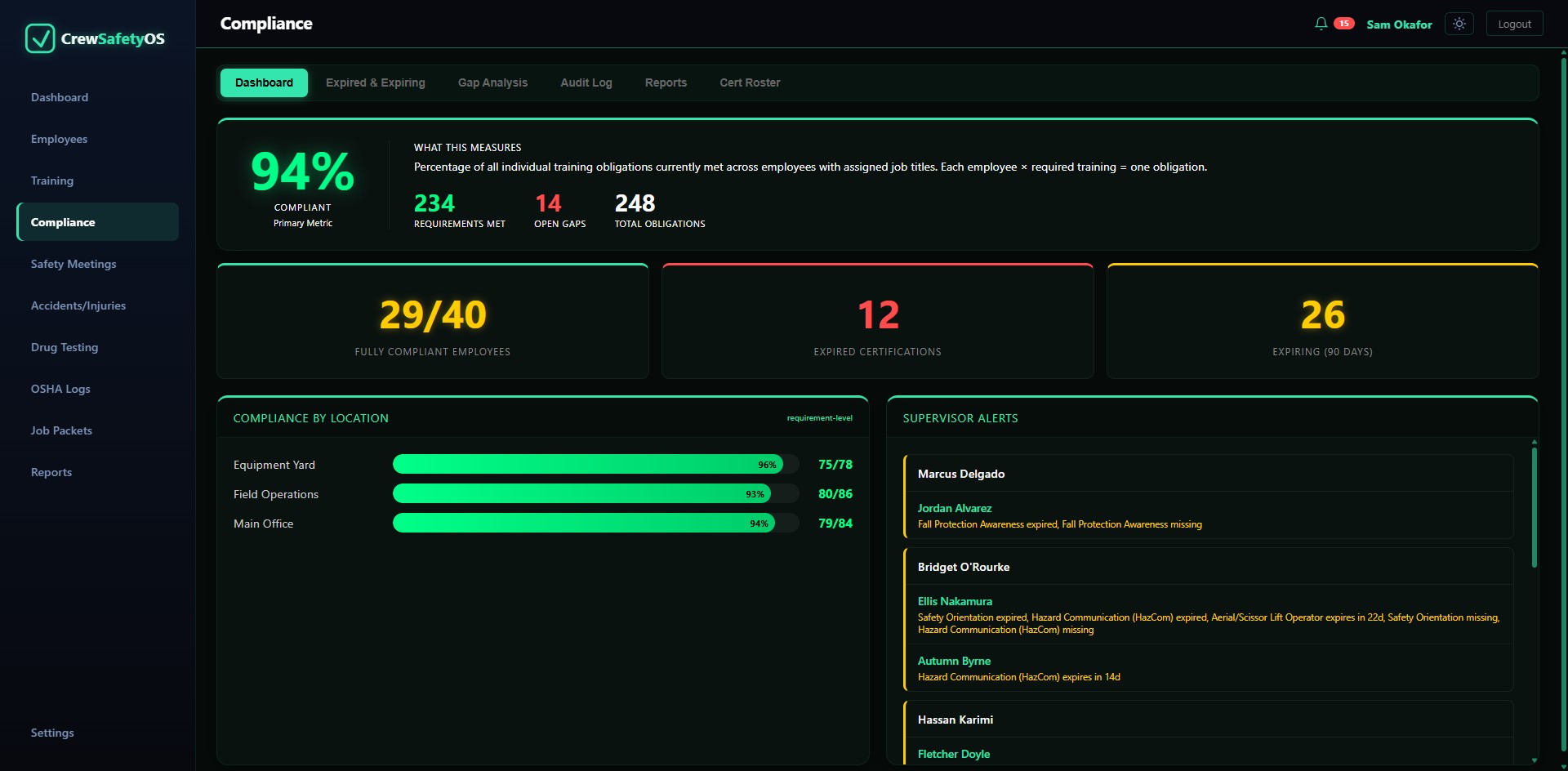
A number no operations dashboard tile could have summarized.
Nobody filled out an inspection or assigned a training module to make this exist. It's computed from every person's credential dates and recomputed as those dates move, which is why it can name the twelve cards that have already expired. In a platform covering inspections, training, incident reporting, assets, and more all at once, credential expiry is easy to leave as one field among many. Here it's the whole point.
Questions
What people ask about the rebrand, and switching to CrewSafety
Is Mitti the same company as SafetyCulture?
Yes. SafetyCulture rebranded as Mitti on August 11, 2026. It's the same company and the same product line under a new name, not a different tool. safetyculture.com now redirects to mitti.com.
Is CrewSafety a replacement for Mitti?
Not for the operational ground Mitti covers: inspections, training assignments, incident reporting, asset tracking, quality checks, procurement, and insurance workflows. CrewSafety is narrower and deeper on one thing: is this specific person, on this specific crew, actually qualified and current on every credential they need today. Some crews run Mitti for the wider operation and CrewSafety for the credential record specifically.
How does CrewSafety's pricing compare to Mitti's?
Mitti publishes its pricing directly at mitti.com/pricing (checked 2026-09-18): a Free plan at $0, Premium at $24 per seat per month billed annually (or $29 per seat per month billed monthly), and a custom-priced Enterprise tier. CrewSafety publishes every tier's price on /pricing too, no sales call required; the Growth tier is a flat $649 a month for 50 profiles, not a per-seat rate.
Can I use CrewSafety and Mitti together?
Yes. They cover different jobs, so there's no conflict running both: Mitti for inspections, training assignments, and the wider operation, CrewSafety for the credential record that answers whether someone is cleared to be on site at all.
Does CrewSafety help with audit readiness the way Mitti's inspection trail does?
Differently. Mitti's inspection and audit trail captures what a walk-around found, in the moment, with photos and notes attached. CrewSafety's audit readiness is about the credential file itself: whether every certification on a person's record is current, what's expiring next, and whether the paperwork would hold up if an auditor asked for it today.
You don't have to decide this in the abstract.
Enter your active roster and let the credential engine do what an inspection platform can't: run the clock on every person's standing, in the background, every day. You'll know immediately if someone's missing a prerequisite, without needing a foreman to catch it on a checklist first. Five profiles, free forever. No credit card, no sales call.